Zero-code AI robotics
Humans teach
the work.
Robots learn it.
Stop programming robots. Start showing them what to do. A worker demonstrates the task with our grippers — Ludis turns it into training data, and the robot learns to handle the real-world variation. Built on the Universal Manipulation Interface.
Before you commit
Is Ludis right for you?
Honest adoption starts with hard questions — about your task, your reliability bar, the economics, and us. Here's the checklist we'd work through with you. A fit is proven in a pilot, not a pitch.
07 Is my task a good match for this paradigm?
- Is it genuine manipulation — grasping, placing, inserting, folding — rather than something a simpler machine could do?
- How repetitive vs. variable is it? Learned policies tolerate some variation but get shaky with high variability or many edge cases.
- What precision and tolerance does it need? Sub-millimeter assembly is a different beast than "drop item in bin."
- Are the objects awkward — deformable, transparent, reflective, fragile, heavy? Those are classically hard.
- Is the work environment controlled, or messy and unpredictable?
- How long is the task horizon? A single short action is far easier than a long multi-step sequence.
- Can the policy hit your required cycle time, or only do it slowly?
03 What reliability do I actually need — and can it clear that bar?
- What success rate is acceptable — 95%? 99.9%? Many learned systems plateau below industrial-grade reliability for critical steps.
- What is the cost of a failure — scrap, safety, downstream defects?
- How are exceptions and recovery handled? Is there a human fallback when it gets confused?
03 Is the data / demonstration side feasible for me?
- Who collects the demonstrations, how many are needed, and how good do they have to be?
- When my product or task changes, do I have to re-demonstrate everything — and how painful is that?
- Do I need in-house ML/robotics talent to keep it healthy, or is it turnkey?
03 Does the economics work?
- Total cost: hardware, integration, licensing, ongoing maintenance — not just the sticker price.
- What labor or throughput am I actually displacing, and what is the payback period?
- How does it compare to my real alternatives: fixed automation, a conventionally programmed arm, or keeping humans?
03 How does it fit my operation?
- Footprint, power, safety guarding, and how it slots into my existing line / workflow.
- Uptime, support, SLAs — and who is on the hook when it breaks.
- Update path when tasks evolve.
03 Is Ludis itself a safe bet?
- How mature are they — funding, track record, real deployed customers in my industry?
- Since UMI is published research, what is their actual proprietary value-add and moat?
- Lock-in risk: what happens to my line if they fold or get acquired?
02 Safety, compliance, and people
- Human-robot safety, plus any regulatory constraints (food, pharma, medical, etc.).
- Workforce impact, change management, and acceptance.
01 Can I de-risk before committing?
- Is there a narrow, low-stakes pilot task I can run first — to get real data before betting the operation on it?
No fabricated benchmarks here — bring these questions and we'll answer them against your task, with a low-stakes pilot to get real numbers first.
The problem
Traditional automation can't keep up with real work.
Conventional robots are hard-coded for one rigid motion. Reality isn't rigid — parts move, deform, and arrive out of place. So the work stays manual.
Hard-coded robots
- ×Hundreds of engineering hours to program one task
- ×Breaks when a part shifts by a single millimeter
- ×One cell, one task — no tolerance for variation
- ×Every product change means re-programming
Show, don't program
- →A worker demonstrates the task in minutes
- →Learns to handle misaligned, moving, messy parts
- →The same skill transfers across the fleet
- →New tasks mean more demos — not more code
How it works
Teach a robot the way you'd teach a person — by showing it.
No code, no teleoperation rig, no robot on day one — and no line downtime. Workers train just 1–2 hours a day while normal production continues.
Demonstrate
Pick up the grippers and do the task by hand — packing, sorting, assembling. They move like your own hands, so there's nothing to learn.
Record
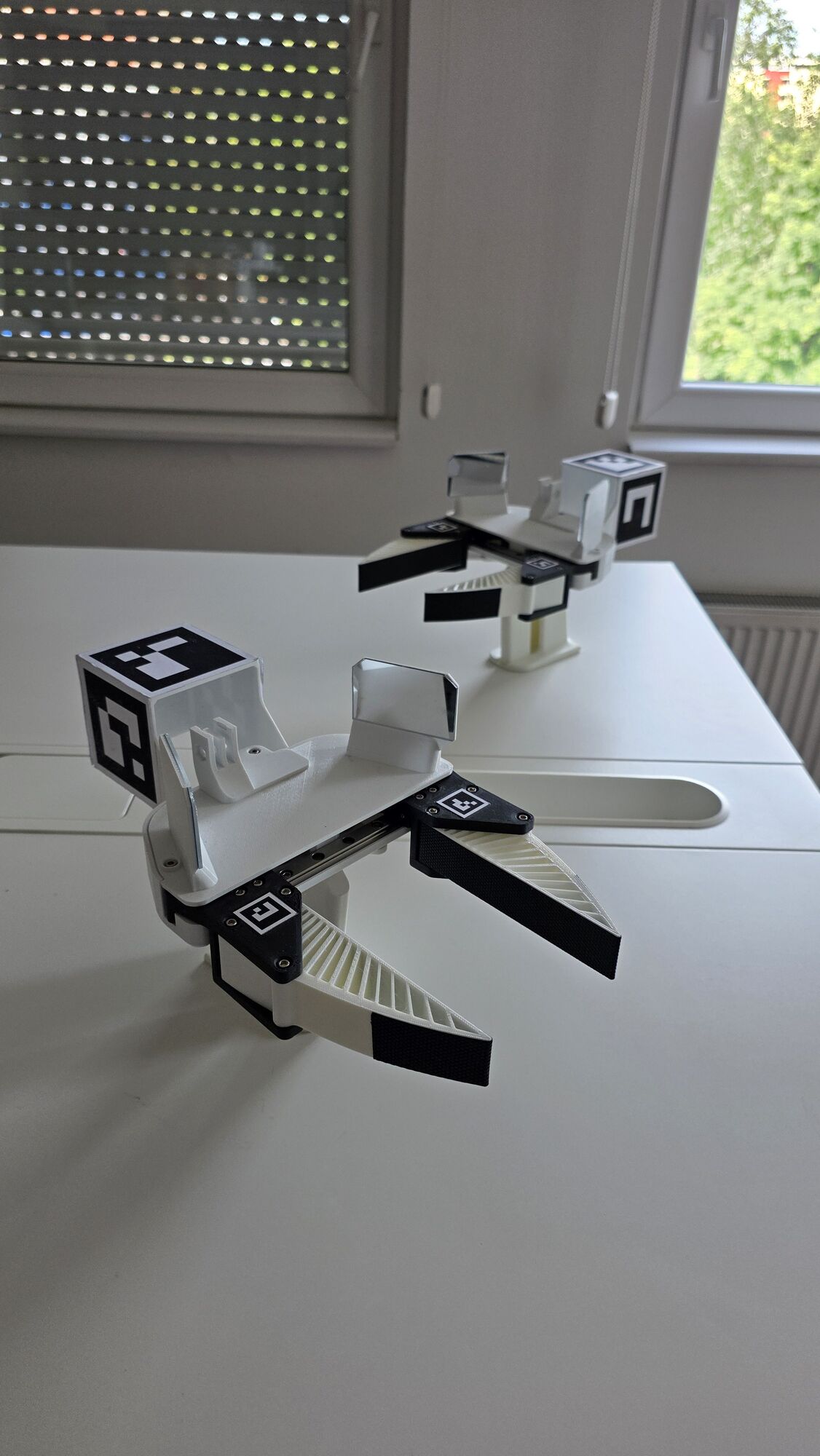
Two wrist fisheye cameras — with side mirrors for implicit stereo — plus a chest camera capture the scene. ArUco markers track each gripper in full 6-DoF. No motion-capture stage required.
Automate
Upload the session. A diffusion policy learns the task — reacting to misaligned and moving parts — then the same gripper runs it on a standard robot arm, autonomously.
See the transfer
One demonstration. Then the robot does it.
Record a person doing the task once. The same gripper — mounted on a standard robot arm — reproduces it autonomously, handling the variation a hard-coded program never could.
The device
A data-collection tool, not a robot.
Twin grippers
3D-printed jaws that mirror a parallel robot gripper — what you do maps one-to-one to what the robot will do. ~85 mm stroke, recovered straight from the markers.
Three fisheye cameras
Two GoPros at the wrists (155° Max Lens, 2.7K/60) with side mirrors for implicit stereo, plus a chest GoPro for egocentric scene context.
Fiducial pose
ArUco DICT_4×4 markers recover precise 6-DoF gripper pose and jaw width frame by frame — identity and position in one mark.
Just record
Battery-powered, untethered, audio-synced across cameras. Capture on the line, in the warehouse, anywhere the real work happens.
The engine
From demonstration to dataset, automatically.
Every session runs through a visual-inertial pipeline that reconstructs exactly what your hands did — in metric 3D, frame by frame.
Capture
3 synced cameras
Map
SLAM workspace
Localize
6-DoF trajectory
Detect
fiducial + jaw width
Plan
build dataset
Train
diffusion policy
Built on proven research
The data flywheel
Labor becomes data. Data becomes autonomy.
Conventional robot programming doesn't scale past one cell. Demonstrations do — and they get cheaper every shift.
Capture
Operators record demonstrations during normal shifts.
Train
Sessions upload and feed a continuously improving policy.
Deploy
Trained skills run on autonomous robots on the floor.
Compound
Every new site and task makes the whole fleet smarter.
Where it works
Start with the tasks robots can't be programmed to do.
If a person can show it in a few minutes, Ludis can capture it.
Dynamic kitting & sorting
Sorting heterogeneous components — valves, bolts, fittings — from messy bins into assembly kits. The policy handles flipped and stacked parts.
Flexible materials handling
Manipulating rubber seals, O-rings, and gaskets that deform as you grip them. Traditional robots struggle here; demonstration-trained policies thrive.
Wire harnessing & routing
Using both grippers to pick up cables and pneumatic hoses and route them into clips and connectors — dexterous, two-handed work.
Deployment
Your data isn't locked to our hardware.
The gripper that records is the gripper that runs. Because capture and deployment share the same end-effector, what the human did maps one-to-one onto the robot — on whatever platform fits your floor.
Industrial cobot arms
Mount the gripper on the proven arms you already trust — Universal Robots, xArm, and similar. The policy runs on hardware your team knows.
Mobile manipulation
Need to cover ground? Place the same arms on standard AGVs to bring trained skills to the line, the bin, or the bench.
Humanoids
Full humanoid hands are a frontier — transfer error is still high. We start you on reliable arms today and explore humanoids as the research matures.
Data & security
Your operations, your data, your model.
The dataset you build is a strategic asset — so it stays yours. We make capture safe to run inside a working facility.
You own the dataset
Every demonstration you record belongs to you. Export the raw data anytime — no lock-in.
You own the policy
The trained model is yours to deploy, retrain, and keep running on your own hardware.
On-prem & air-gapped
Capture and process on-site for sensitive facilities. Nothing has to leave the building.
Encrypted end to end
Footage is encrypted in transit and at rest, with role-based access controls and audit logs.
The math
What does one manual task cost you?
Estimate the labor tied up in a single repetitive handling task today — time you could redeploy to work robots can't do.
Start a pilot
From first demo to deployed in about 60 days.
A pilot proves Ludis on one of your tasks — measured, low-risk, and without disrupting the line.
Equip & onboard
We fit your operators with grippers and set capture up right on your line.
Demonstrate
Your team records the target task 1–2 hours a day. Normal production never stops.
Train
We process the sessions and train the policy off-site on the demonstration data.
Deploy
The policy runs on your cobot arm. You keep the dataset and the trained model.
The team
Robotics, machine learning, and the factory floor.
Replace these placeholders with your founders and key hires — photos, names, and one-line bios.
Co-founder & CEO
Co-founder & CTO
Head of Machine Learning
Field Engineering Lead
FAQ
Questions, answered.
What kinds of tasks can Ludis learn?
How many demonstrations do we need?
Does it work with the robots we already have?
Does collecting data interrupt production?
Who owns the data and the trained model?
How long until it's running autonomously?
Is my task a good fit for Ludis?
What happens when our product or task changes?
Do we need in-house ML or robotics talent?
Teach once.
Robotize the rest.
Bring Ludis to your floor and start building a demonstration dataset this quarter.