How It Works
How it works
Teach a robot the way you'd teach a person - by showing it.
No code, no teleoperation rig, no robot on day one - and no line downtime. Workers train just 1–2 hours a day while normal production continues.
Demonstrate
Pick up the grippers and do the task by hand - packing, sorting, assembling. They move like your own hands, so there's nothing to learn.
Record
Two wrist fisheye cameras - with side mirrors for implicit stereo - plus a chest camera capture the scene. ArUco markers track each gripper in full 6-DoF. No motion-capture stage required.
Automate
Upload the session. A diffusion policy learns the task - reacting to misaligned and moving parts - then the same gripper runs it on a standard robot arm, autonomously.
See the transfer
Demonstrated by hand. Then the robot does it.
Record people doing the task. The same grippers - mounted on standard robot arms - reproduce it autonomously, handling the variation a hard-coded program never could.
A simulated replay on a loop: a worker puts two cups in a dish rack with two handheld grippers, the cameras record their pose, then two robot arms wearing the same grippers repeat it.
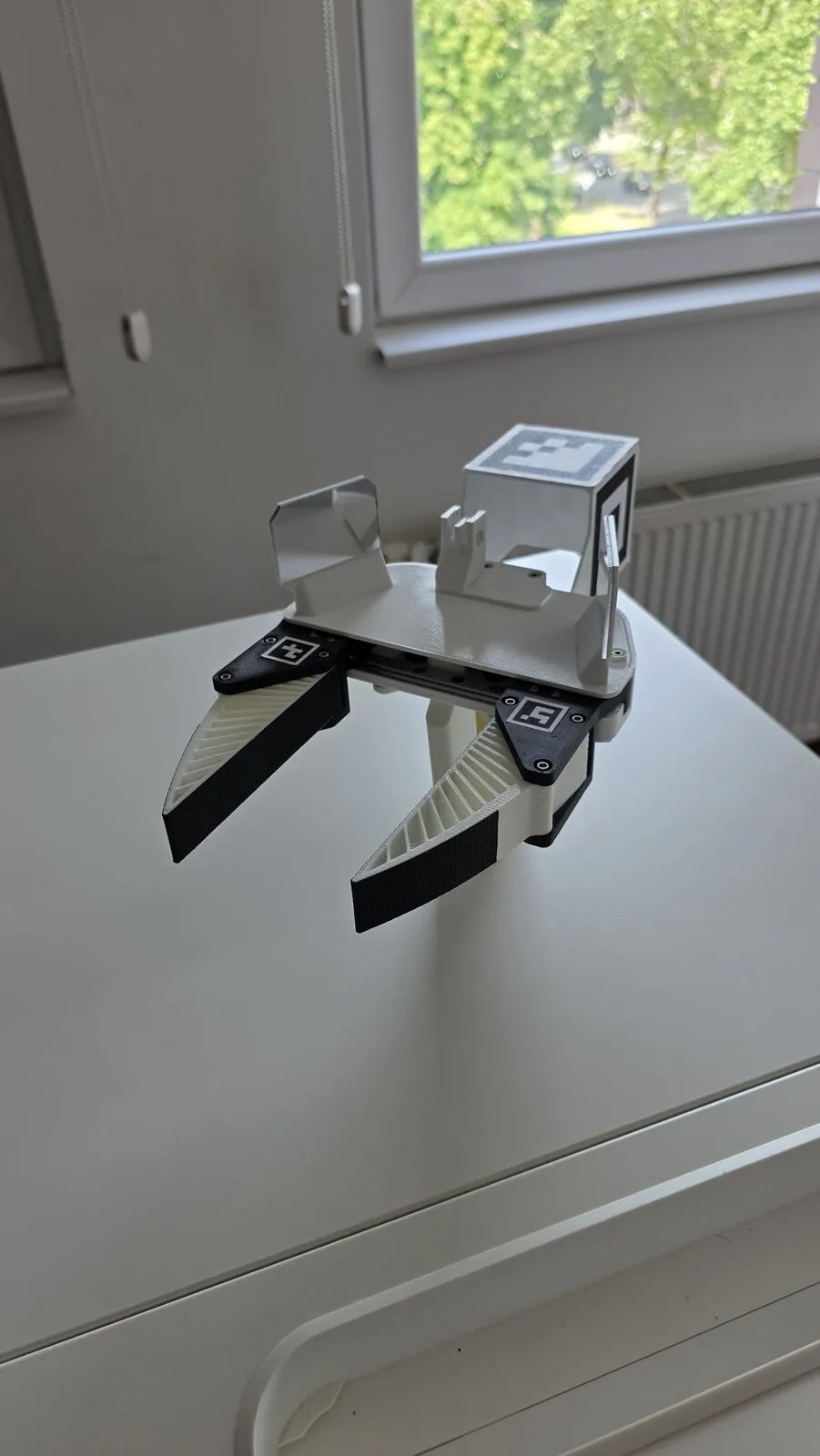
The device
A data-collection tool, not a robot.
Twin grippers
3D-printed jaws that mirror a parallel robot gripper - what you do maps one-to-one to what the robot will do. ~85 mm stroke, recovered straight from the markers.
Three fisheye cameras
Two GoPros at the wrists (155° Max Lens, 2.7K/60) with side mirrors for implicit stereo, plus a chest GoPro for egocentric scene context.
Fiducial pose
ArUco DICT_4×4 markers recover precise 6-DoF gripper pose and jaw width frame by frame - identity and position in one mark.
Just record
Battery-powered, untethered, with sub-millisecond audio sync across cameras and a ChArUco board anchoring every session to metric 3D. Capture on the line, in the warehouse, anywhere the real work happens.
Three cameras, one clock
Every frame lines up.
One real demonstration from our bench. Both wrist cameras and the chest camera, aligned by their audio so each moment shows the same instant from three angles. Scrub through it.
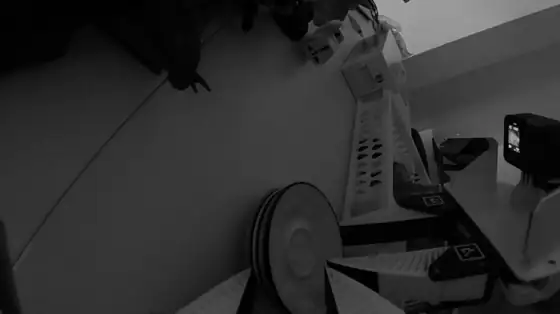
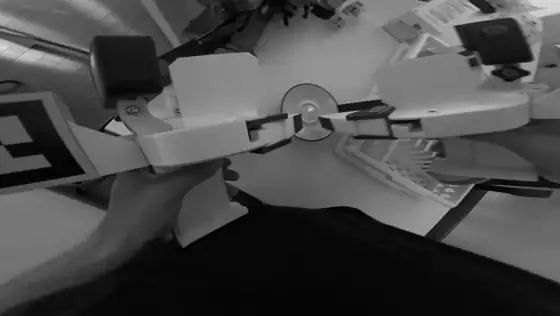
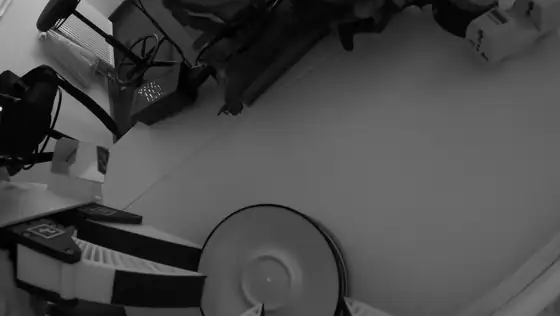
Chest camera is the reference; the wrists follow with their measured audio offsets.
The engine
From demonstration to dataset, automatically.
Every session runs through a visual-inertial pipeline that reconstructs exactly what your hands did - in metric 3D, frame by frame. When a scene is textureless, reflective, or crowded and SLAM would lose tracking, a RealSense T265 or solid-state LiDAR keeps it locked.
Capture
3 synced cameras
Map
SLAM workspace
Localize
6-DoF trajectory
Detect
fiducial + jaw width
Plan
build dataset
Train
diffusion policy
The data flywheel
Labor becomes data. Data becomes autonomy.
Conventional robot programming doesn't scale past one cell. Demonstrations do - and they get cheaper every shift.
Capture
Operators record demonstrations during normal shifts.
Train
Sessions upload and feed a continuously improving policy.
Deploy
Trained skills run on autonomous robots on the floor.
Compound
Every new site and task makes the whole fleet smarter.
Teach the task.
Robotize the rest.
Bring Ludis to your floor. Operators record demonstrations during normal shifts - a few weeks at 1–2 hours a day, no robot on the line.
Opens your email. Or write to info@invt.tech.
- duration
- 0.0 s
- frames
- 0
- path
- 0.00 m
- grips
- 0
- in view
- -
- rate
- 30 Hz
Waiting move, scroll or tap
You showed, it recorded. Now show a robot your real task.
Recorded in this tab only; nothing is sent. ·